CBC News
September 4, 2026
By: Sophie Woodrooffe
Original article here.
Cathedral Grove winner of The Search for B.C.'s Best Roadside Attraction
Cathedral Grove overcomes Barkerville, Mr. PG, Enchanted Forest to be crowned best roadside attraction
Back in 1979 the narrow parking spaces were there, as were the trees. And so was Bill Beese.
He was 23 at the time, working as a summer student for the forestry giant MacMillan Bloedel.
And while he couldn't conduct his field work inside the provincial park, his boss said he and the other students should stop there anyway. Just to look. Or rather, look up.
"We were just awestruck," said Beese.
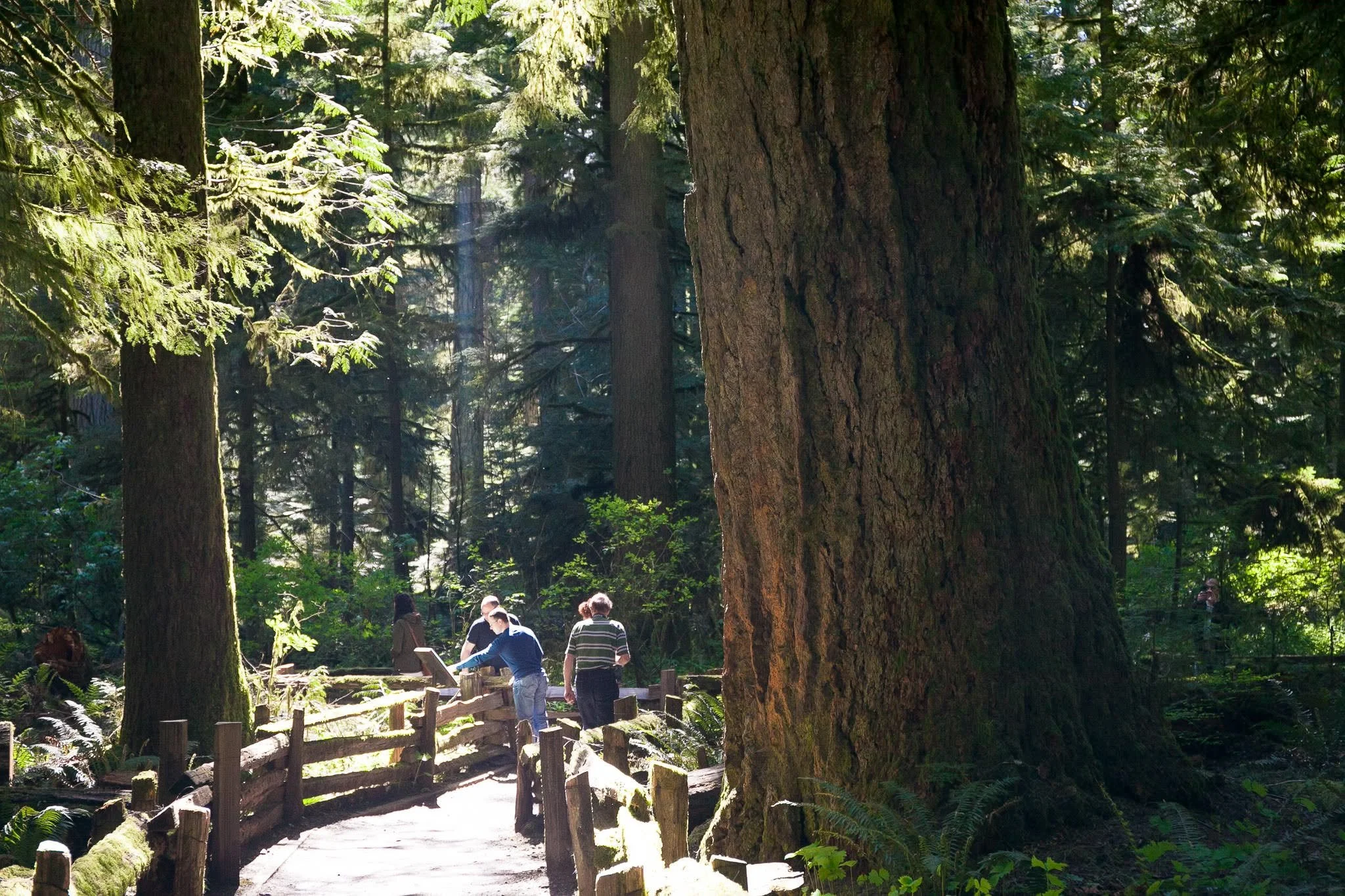
He's from back east and had zero reference for the 800-year-old towers disappearing into the sky, the ferns and glistening strands of cat-tail moss absorbing sound, reflecting light.
"The name Cathedral Grove is very apt."
Nearly 50 years later, Beese is one of the thousands of voters who helped Cathedral Grove beat 31 challengers over the CBC's five-week competition to determine the top thing people like to get out of their cars and look, or look up at.
"It is literally a roadside attraction. The highway goes right through this magnificent old-growth forest. And it's very unique," said Beese, who, as a forest ecologist and retired Vancouver Island University forestry professor, admits bias.
To ascend to greatness as B.C.'s best roadside attraction, Cathedral Grove beat Barkerville in the final by a close margin of 54 to 46 per cent.
The grove also defeated Othello Tunnels in the semifinals and in the quarterfinals decisively dispatched Goats on the Roof in the bracket's Alberni Highway derby, earning 72 per cent of the vote.
But maybe there's an upshot for the goats. "You can do it on the same trip," said Beese. "They can ride on the coattails of the visitors to the grove."
What is it about those trees?
The Douglas fir and other conifers that characterize Cathedral Grove owe their size in part to the fertile soils of the Alberni Valley, in the floodplain of the Cameron River.
The Lower Mainland, Fraser Valley, and Victoria were at one time "dominated" by similar giants, according to Ken Wu, executive director with Endangered Ecosystems Alliance.
Valley bottoms produce head-spinningly humongous trees. They're also great places for cities.
Forester H.R. MacMillan, who owned immense swaths of private land on Vancouver Island, was already logging those valley bottoms in the mid-1900s.
Over the decades, in their place sprang regional economies, sawmills, pulp mills — a new cultural identity emerging that continues to define B.C. even as forestry faces unprecedented challenges.
But the grove is also a cultural site in its own right.
"Four different First Nations' territories overlap in the area and have used ancient cedars and the Pacific Yew trees, the devil's club … for their sustenance, for their culture," said Wu.
As for the rest of B.C.'s coastal low-elevation old growth?
"Exterminated. Gone," said Wu, who devoted years to protecting nearby private lands from logging.
Today, there is "far less than one per cent" left, according to Wu. And Cathedral Grove is the largest representative stand.
The trees are remnants of another time and an icon for what the future could bring, ironically, because of an initial donation by H.R. MacMillan, the founder of the company that hired Beese to conduct ecological research all those years ago.
For Wu, what makes Cathedral Grove great isn't just the ecology, it's what the forest represents to the more than 500,000 people who visit each year.
"It has really been the foundation to raise human consciousness not just in B.C. but around a lot of the world," he said.
"It would be hard to imagine British Columbia without Cathedral Grove."
Let's just ignore the parking lot for now.